
September 18, 2025 0 Comments

7 Best Buy to Let Places in UK 2025: Proven Cities for Strong Returns


Introduction: Why Buy-to-Let Still Works in 2025

In 2025, the UK buy-to-let market continues to attract both seasoned and overseas investors looking for stable, long-term income. Despite tax changes and tighter regulations, strong rental demand, affordable regional property prices, and capital growth opportunities make buy-to-let a compelling strategy.

According to the ONS, the UK average house price reached £269,000 in June 2025, up 3.7% year-on-year. Meanwhile, national gross rental yields now average 7.03%, an improvement from late 2024. Even with a 16% drop in demand year-on-year, rental competition remains 60% higher than pre-pandemic levels, confirming the ongoing imbalance between supply and demand.

Invest in UK Property (IIUKP) is dedicated to guiding international investors through these opportunities — from selecting the right city to navigating the entire purchase process.

Further Reading: Latest market data from ONS, UK Land Registry, HomeLet, Zoopla, and Savills.

London (Zones 3–6)

London remains the most recognisable buy-to-let destination globally. However, investors are shifting away from expensive central districts to outer Zones 3–6, where affordability, regeneration, and connectivity combine to create stronger yields.

  • Prime central London yields average just 2.5–3.0%.
  • Zones 3–6 boroughs such as Barking & Dagenham (5.7%), Newham (5.5%), and Lewisham (5.2%) deliver far stronger returns.

The Elizabeth Line (Crossrail) has transformed connectivity, leading to a surge in values near stations and facilitating commuting from affordable areas into central London. Regeneration schemes — from Barking Riverside (10,800 new homes) to Croydon’s tech hub and Woolwich riverside — continue to reshape these boroughs.

Key Takeaways: London

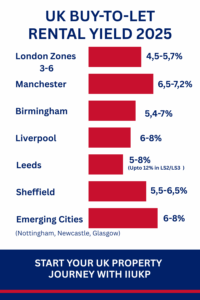
  • Best yields are in outer boroughs (4.5–5.7%).
  • Connectivity and regeneration drive long-term appreciation.
  • Attractive for overseas investors seeking global recognition + stable demand.

Further Reading: See insights from Savills, TfL Elizabeth Line report, and the UK Gov’s Barking Riverside funding announcement.

Manchester

Manchester remains the UK’s “second city” for investment, offering high yields and long-term growth.

  • Salford Quays and MediaCityUK yields: 6.5–7.2%.
  • City centre/Northern Quarter yields: 5.5–6.0%.

Major regeneration projects like MediaCityUK and the £1bn Northern Gateway, which will deliver 15,000 homes and 20,000 jobs, are transforming the cityscape. Manchester also retains 51% of graduates and is set for 10% student population growth in 2025, ensuring a steady stream of rental demand.

Key Takeaways: Manchester

  • Consistently high yields above 6%.
  • Strong student and graduate demand.
  • Regeneration projects position it as a long-term hotspot.

Further Reading: Market data from ONS, Zoopla, and regeneration plans via Manchester Council plus graduate retention reports from Manchester Council.

Birmingham

Birmingham’s property market is powered by regeneration and infrastructure improvements.

The HS2 project, connecting Birmingham to London in under an hour, is expected to add £10bn to the West Midlands economy. The Smithfield redevelopment (£470m) and the Big City Plan are transforming the urban core with new homes, office space, and cultural districts.

  • Average Birmingham yield: 5.4%.
  • Studio apartments can achieve 7%, while one-beds deliver 6.2%.

Key Takeaways: Birmingham

  • HS2 connectivity is a major investment catalyst.
  • Affordable entry prices with strong yield potential.
  • Regeneration boosting appeal for young professionals.

Further Reading: Explore HS2’s economic impact, Birmingham Smithfield Masterplan, and housing data from ONS.

Liverpool

Liverpool combines affordability with some of the UK’s strongest yields.

  • Average house price: £174,000, well below the national average.
  • Yields in Baltic Triangle and Knowledge Quarter: 6–8%.

The city’s 70,000+ students ensure steady rental demand, while regeneration in the docklands, Pumpfields, and Vauxhall drives capital appreciation.

Key Takeaways: Liverpool

  • Low entry prices compared to the UK average.
  • Among the UK’s highest yields (up to 8%).
  • Strong student and regeneration-led demand.

Further Reading: See property and rental data from ONS, student housing insights from Liverpool Council, and regeneration vision via Liverpool Waterfront Plan.

Join our newsletter for exclusive property investment updates.

Leeds & Sheffield

Both Leeds and Sheffield are Northern Powerhouse cities with strong fundamentals.

Leeds:

  • Tech sector growing 125% faster than UK average.
  • 60,000+ students, with 42% graduate retention.
  • Rental yields: 5–8%, with LS2 and LS3 postcodes reaching 9–12%.

Sheffield:

  • Heart of the City (£470m) and Kelham Island regeneration projects.
  • Yields: 5.5–6.5% on average, with higher returns in central areas.

Key Takeaways: Leeds & Sheffield

  • Leeds leads as a digital and financial hub with high yields.
  • Sheffield regeneration strengthens rental demand.
  • Both offer strong tenant bases from students + professionals.

Further Reading: Learn more from UCAS, Leeds Council, Sheffield Council, and rental data from HomeLet.

Emerging Cities: Nottingham, Newcastle, Glasgow

For investors seeking affordability and growth, emerging cities provide excellent opportunities.

Nottingham

  • 65,000+ students and affordability underpin rental demand.
  • Yields average 6–8%.

Newcastle

  • Benefiting from Northern Powerhouse infrastructure upgrades.
  • Regeneration along the Quayside attracts both professionals and students.

Glasgow

  • 2,184 BTR units operational, 6,254 in pipeline.
  • Average BTR rent for a one-bed: £1,299/month.
  • Yields range: 6–8%.

Key Takeaways: Emerging Cities

  • Nottingham = affordability + student-driven demand.
  • Newcastle = Northern Powerhouse + strong rental base.
  • Glasgow = BTR pipeline + regeneration boost.

Further Reading: Nottingham student housing data via Nottingham Council, Newcastle regeneration from UK Gov, and Glasgow BTR insights from CBRE and the Scottish Government.

Conclusion: Outlook for 2025 and Beyond

Forecasts remain optimistic for the UK property market. Knight Frank predicts 2.5% house price growth in 2025 and 3% in 2026, while Savills forecasts a 21.6% cumulative rise by 2029. Rental growth is expected to remain robust, with Knight Frank projecting 17.6% by 2029 and JLL estimating 18.8% in Greater London.

Investor confidence is rising, supported by planning reforms and interest rate cuts. Both CBRE and IPF report a projected 15% increase in investment volumes in 2025.

Actionable Steps

  1. Identify your target city: Match budget and goals with London, Manchester, Birmingham, Liverpool, Leeds/Sheffield, or emerging cities.
  2. Evaluate yields vs growth: Prioritise high-yield regions for income, regeneration zones for long-term capital appreciation.
  3. Register with IIUKP: Gain access to pre-vetted, off-market opportunities tailored to overseas investors.
  4. Book a consultation: Ensure full legal, financial, and compliance guidance before purchase.

Further Reading: Market outlooks from Savills, Knight Frank, JLL, and investor sentiment via IPF.

High-Yield Investment Opportunities

Gain access to exclusive off-market property deals, tailored investment strategies, and expert guidance.
Whether you're ready to invest or need personalized consultation, we're here to help you maximize your returns.


Mission Statement

“Invest in the best” and create maximum value for our investors.”

–Mir Faisal Talpur

Leave a Comment

Your email address will not be published.

Our time: 10:16am UTC